Generating Polygonal Surface
 Range Data
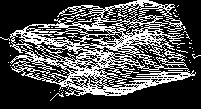
We measured the 3D shape of a replica of a hand made of plaster. We
used a laser range-finder with linear motion platform to obtain shape
data set of the palm and the back side separately. Each range data set
is composed of 512x512 3D points.
We transformed the dorsal aspect data set to the coordinate system of the
palmar side and adjusted the 3D positions of two data sets, based on the
position of the markers included in both data set, by minimizing the
quadratic error. In this way, we could get the range data of a whole
hand.
Polygon Vertices
We assigned a hand posture similar to the one of the
digitized hand of the skeletal model, and positioned the skeletal model
into the digitized 3D shape of the hand manually.

The scanning lines of palmar and dorsal sides will become unaligned after regitration of
the 2 data sets. We construct the polygon model to describe the
hand surface as follows.
1. Settle 50 parallel section planes which across the skeletal links.
2. Project all points of range data onto the nearest section plane.
3. Assign the projected points to the nearest skeletal link on each section plane.
4. For each group of the projected points belonging to the same link, transform the coordinate of each point to a polar coordinate system, where the origin is set at the link. Create 10 new points of which angles are defined on even intervals.

[Next] "Rendering"
[Back] "Posture Determination"
[Project Summary] [Home]