|
English/Japanese |
Today, all around Japan, a large number of relics are excavated one after another in archaeological investigations before construction. However, not only common relics but even also important ones cannot be well preserved because of a shortage of budget, political decision or geographical difficulties.
When the as-it-is preservation is difficult, measured drawings and photographs from various points of view are used for recording of relics. However, this traditional method has the following disadvantages:
Moreover, if the relic itself is preserved, or a replica of the relic is made, some problems still remains:
Accordingly, the information technology is applied to the preservation of relics. The information technology solve the problems above by following ways:
The subject of this research is Kamegata-Ishi(Turtle Shaped Stone) and we made the best use of information technology when we archived the stone digitally. This paper presents how to create scientifically verifiable virtual reality reconstructions from heterogeneous measurements.
Kamegata-Ishi(Turtle Shape Stone) is a relic of the Asuka Era made by granite and was discovered at the Sakafune-Ishi ruins(Nara, Japan), on January 11, 2000. Figure 1 are photographs of Kamegata-Ishi.
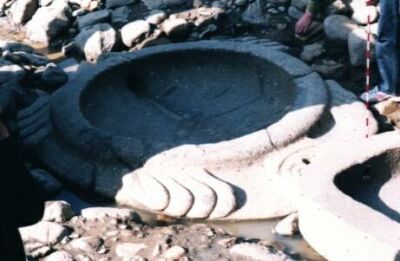
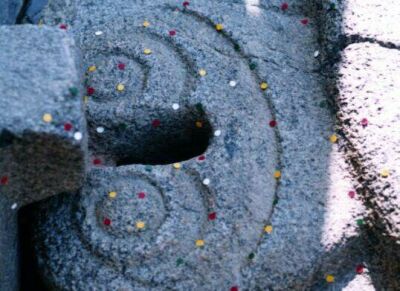
The size of Kamegata-Ishi is shown in Table 1.
| Width | 2.0m |
| Length | 2.4m |
| Height | 0.6m |
| Diameter of carapace | 1.25m |
The stone was scraped out from one granite stone precisely and a face, hands and feet are drawn as geometric pattern on surface. The stone has two hole in face (for nose and mouth) and one hone in tail. These detailed handiworks indicate that the technique of stone scraping at the Asuka Era was unexpectedly sophisticated.
The same excavation found out tub-like stone relic and stone-paved square and steps with Kamegata-Ishi. The kind of the paved stone of the square reveals that this relic was built by Empress Saimei(reigned from 655 to 661).
The structure of Kamegata-Ishi indicates that the stone can flush and store water so we can guess that this relic is used for some kind of rites with water. In the Asuka era, many peculiar stone objects are constructed (such as Kameishi, Sakafune-Ishi etc.) and the relationship between them(including Kamegata-Ishi) has been discussing for a long time. Therefore, the stone is expected to provide new clues to elucidate the culture of Asuka era.
To preserve historical relics the color and the shape of the object are indispensable. (Spectrum, material, weight are also need in some case.) In case of this research, the authors adopted the heterogeneous methods, which measure the object using a total station, non-contact 3-D digitizer and stereo photographs. The procedure is shown as Figure 2.
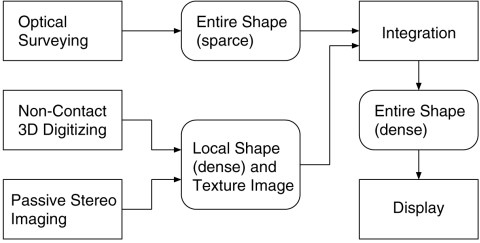
The measurement was executed on March 26, 2000.
First, markers are put on Kamegata-Ishi. The diameter of the marker is about 2cm. The corners and edges of the object are marked selectively and on the plain surface markers are distributed randomly. The color of the markers are selected in the way that the color of one marker is differs from the color of any neighbour marker. This way of assignment of color is convenient for abstraction of markers when automatic stereo matching. The markers are used for
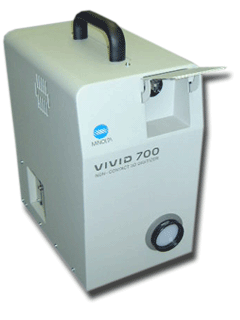
Next, three measurement methods are executed simultaneously. We used electronic total station SET6E(Sokkia) for optical surveying, VIVID 700(Minolta) for 3D digitizing and 35mm film cameras for passive stereo imaging. These apparatus are shown as Figure 3.
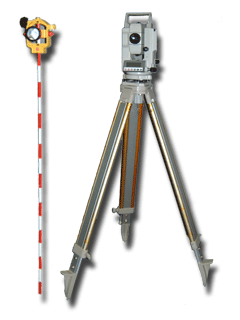
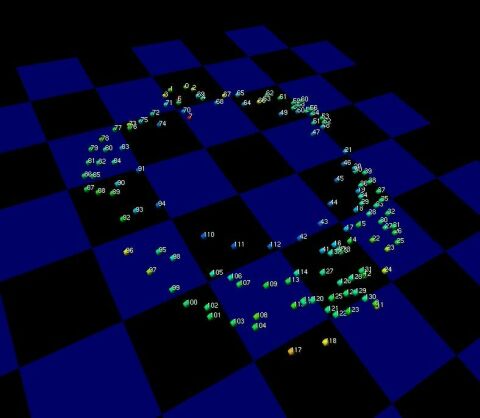
The result of optical surveying is represented as the distance between the total station and the prism and the angle of depression from the total station to the prism. To make it easy to handle the given data set, The each point is translated to the representation in Cartesian coordinate. The entire shape is shown as Figure 4.
The method how to caliculate distance from a pair of stereo images is as follows.
z(u,v) = l f / d(u,v)In this measurement, a length of the baseline l is 220mm and the focus length is f 85mm.
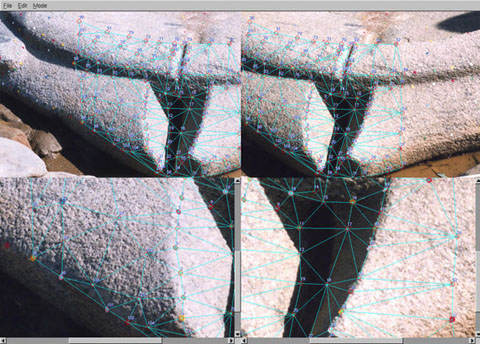
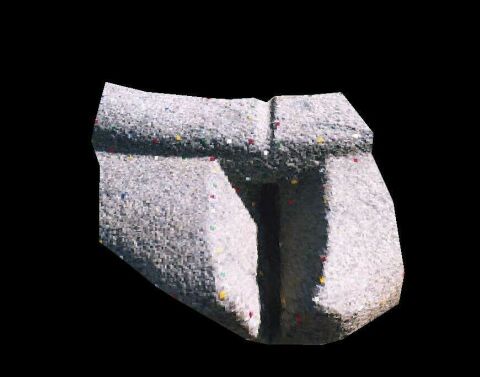
The result is given as the structure and texture image and each point's texture position. For integration, we found out the markers from the texture image and the local position of the point.
To obtain detailed entire shape of the stone, the local shapes have to be located on precise position in the entire shape. This registration is achieved through the transformation by which each marker of the local shape matches the corresponding marker of the entire shape. The correspondence between markers are given by user.
Next, the transformation matrix from local system to global system is calculated. We assume that there are local points pi and the corresponding points qi (i = 1 ... N). The transformation matrix G is determined in the simulated annealing. The detail of the simulated annealing is as follows:
G' = R GThe disturbance has three types:
E(G) = \sum i=1N ( qi - G pi )2If E(G') < E(G), we adopt G' as new G. If E(G') > E(G), we adopt G' with probability exp(E(G)-E(G')/T).
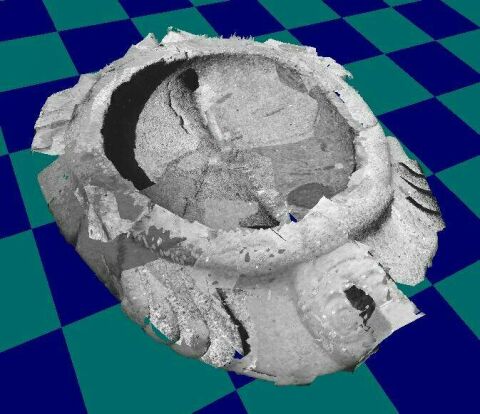
The reconstructed model of Kamegata-Ishi is rendered by Onyx2 and we can see the stereo image with stereo glasses from any point of view.
The reconstructed image of Kamegata-Ishi is shown as Figure 7.
The method we adopt has the following advantages:
On the other hand, some problems still remains.
We archived Kamegata-Ishi(Turtle Shaped Stone) digitally with the heterogeneous measurement methods. Our measurement method is fast and objective, that is applicable for mounting excavation of relics.
This research is in cooperation with Asuka Villege(Nara, Japan) and Nara National Cultural Properties Research Institute. The measurement was completed thanks to Y. Iguchi, K. Sasaki, T. Hayashi and A. Machida, who are members of Image Processing Laboratory, Nara Institute of Science and Technology.
MPEG1 demo movie is
HERE(6.0MB).
| Back | e-mail: masata-i@is.aist-nara.ac.jp last update: Aug. 29, 2001 |
 Research #2