
During the last decade, the ultrasound transducers have been reduced to a smaller size which can be set easily on a catheter tip. As a result, it becomes possible to develop an intravascular ultrasound (IVUS) endoscope to observe the inside of a blood vessel from a very close position. In recent medical sciences, IVUS endoscope plays a pivotal role to provide information concerning the blood vessels morphology. It also helps the non-invasive testing of patients with vascular diseases like atherosclerosis, blood vessel stricture, blood vessel lesion, etc.
In most conventional IVUS endoscope, a cross section of a blood vessel is obtained by scanning an ultrasound beam radially. In this method, an ultrasound beam is rotated by a mechanical motor located at the outside of the human body, connected with a beam reflecting mirror inside the catheter through a rotation transmitting wire. One of the disadvantage of this system is the mechanical vibration which spread through the rotation transmitting wire. This disadvantage is caused by the rotation of the mechanical motor, so that, it results in wrench and snap of the rotation transmitting wire and even harmful to a blood vessel. Furthermore, the images reconstructed from this system can not correspond to the accurate structures of the blood vessels due to the unstable rotation of the mechanical motor.
To solve the above problems, we proposed a new scanning method using a micromotor instead of a mechanical motor where rotation transmitting wire was not required. We developed a catheter for this micromotor type IVUS endoscope method and calibrated it through phantom experiments. Finally, we applied it to observe the inside of blood vessel by an in vitro experiment.
Micromotor Type IVUS
- Concept:
In micromotor type IVUS endoscope, a magnet, an ultrasound beam reflecting mirror and an ultrasound transducer are inserted into a catheter. The rotation of the micromotor is performed and controlled by an external magnetic field.
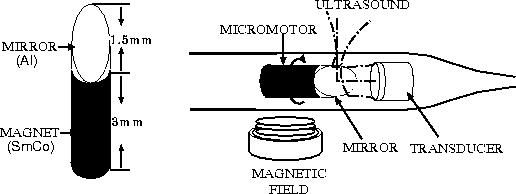
As shown in Figure, a {\rm SmCo} permanent magnet is used as a micromotor having cylinder-shaped (1\,mm diameter, 3\,mm length). On the tip of the micromotor, an {\rm Al} beam reflecting mirror having oval-shaped (1\,mm diameter) is attached.
- Catheter:
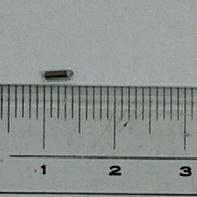
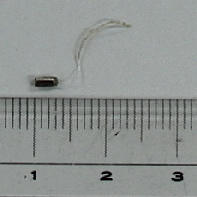
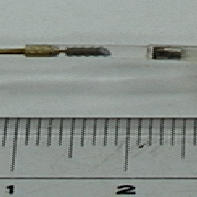
Figure shows a photograph of the magnet attached with a mirror, a photograph of the ultrasound transducer and a photograph of the catheter which we have developed for the experiments. In the catheter the micromotor is mounted on a shaft (1.4mm diameter) for smooth rotation around the axis. The ultrasonic transducer has resonant frequency of 20MHz and a diameter of 1.2mm. The micromotor, the mirror and the transducer are mounted in a tube of diameter 1.5mm. The distance between the mirror and the transducer is set at 3mm. The width of our catheter is 1.5mm, so that, it has enough ability to visualize the human arterial lumen having diameter 3mm.
- Characteristics of the micromotor's rotation:
The magnet part of the micromotor having two poles can be rotated by an external sinuous magnetic field. The rotation can be controlled by the same external magnetic field. The rotation frequency of the micromotor is proportional to the frequency of the external magnetic field. In the magnitude range over 0.15mT and the frequency range 25-110Hz, the rotation of the micromotor is stable. The micromotor does not rotate when the magnitude is less than 0.15mT. The frequency range of the micromotor rotation increases in proportional to the magnitude of the external magnetic field.
Measurement System
The following figure is the block diagram of the data acquisition system.
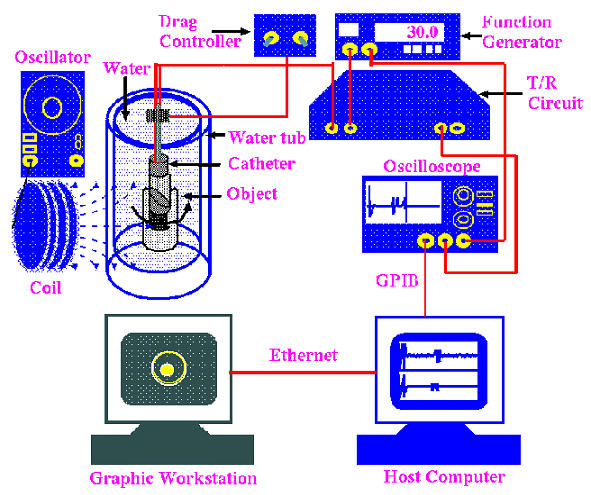
The catheter is inserted into the object and
placed into a water tub.
Inside the catheter, 20MHz burst waves are transmitted from the
transducer towards the object through the beam reflecting mirror
at a repetition frequency of 10kHz. The micromotor rotation is
set at 60rpm and it corresponds to 167 scanning lines.
Echo signals reflected from the
object are received by the same transducer. The echo signals are
amplified and stored in a digital storage oscilloscope (LeCroy 9354L)
at a sampling rate of 250MHz and a gray scale level of 8-bit.
The stored data are then transferred to a host
computer (Sun SPARC station 20) through GPIB and filtered by a
band-pass filter of 17-23.5MHz to enhance the S/N
ratio. Finally, the filtered data are transferred to a graphical
workstation (SGI Indigo$^2$)
through ethernet where the cross sectional image of the object is
reconstructed.
Image Reconstruction Process
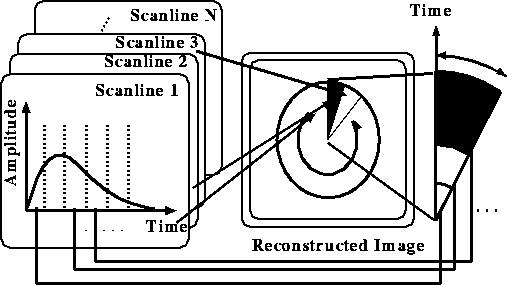
In the image reconstruction process, first, the absolute value of the echo signals from 167 scan lines were calculated. Second, the absolute values were quantized to a 8-bit gray scale level corresponding with their intensity level. Finally, the gray scale data of each scan line in order of their receiving period, are plotted radially in the display of the graphical workstation. The gap between scan lines are filled with a linear interpolation.
Experiments and Results
- Phantom Experiment
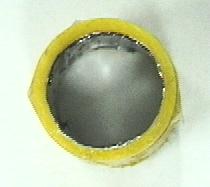
Using this new micromotor intravascular ultrasonic imaging system,
a phantom experiment was carried out
on a plastic tube as shown in following figure.
The experiment was done in a water tub.
The micromotor rotation was set at 50rpm.
In this experiment, 167 scan lines are used
for image reconstruction.
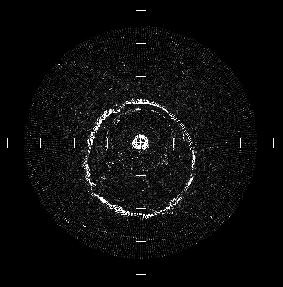
The following figure shows the reconstructed cross sectional image
of the plastic tube as shown in above figure.
The scale in the image is 2.5 mm/div.
In this figure, the cross section of a glass tube is reconstructed
at the distance of 8-11mm from the center.
- In Vitro Experiment
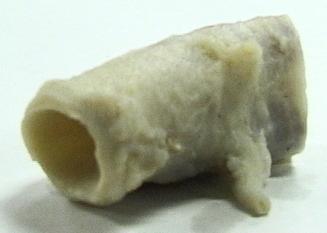
An in vitro experiment was carried on 1 human abdominal aorta to visualize
the arterial wall. The arterial specimen was provided by Osaka National Hospital.
The arterial specimen was mounted on the frame in the water tub and then the
catheter was inserted into the arterial specimens for imaging. The following
figure shows the arterial specimen.
The following figure shows the reconstructed cross sectional image
of the arterial wall as shown in above figure.
The scale in the image is 2.5 mm/div.
In this figure, the cross section of a artery is reconstructed
at the distance of 6-8mm from the center.

Using this new micromotor intravascular ultrasonic imaging system, a phantom experiment was carried out on a plastic tube as shown in following figure. The experiment was done in a water tub. The micromotor rotation was set at 50rpm. In this experiment, 167 scan lines are used for image reconstruction.
The following figure shows the reconstructed cross sectional image of the plastic tube as shown in above figure. The scale in the image is 2.5 mm/div. In this figure, the cross section of a glass tube is reconstructed at the distance of 8-11mm from the center.
An in vitro experiment was carried on 1 human abdominal aorta to visualize the arterial wall. The arterial specimen was provided by Osaka National Hospital. The arterial specimen was mounted on the frame in the water tub and then the catheter was inserted into the arterial specimens for imaging. The following figure shows the arterial specimen.
The following figure shows the reconstructed cross sectional image of the arterial wall as shown in above figure. The scale in the image is 2.5 mm/div. In this figure, the cross section of a artery is reconstructed at the distance of 6-8mm from the center.
Conclusions
We have developed a new lateral-viewing micromotor type IVUS endoscope. To evaluate the measurement accuracy of this micromotor type IVUS endoscope, we performed several phantom experiments and applied this to observe the inside of human arterial specimens through in vitro experiments. The reconstructed images demonstrated that the lateral-viewing micromotor type IVUS endoscope had the potential to visualize the arterial wall accurately. Furthermore, it could measure the arterial wall thickness to diagnose diseases like blood vessel stricture, vessel lesion, etc.
These preliminary experiment results were very encouraging.
These results suggested that this technique is promising for an
IVUS endoscope and that it can solve the rotation transmitting wire
problem of conventional IVUS endoscope.
Our research on lateral-viewing micromotor type IVUS endoscope
is in the preliminary stage now and in future, it is needed to proceed
in vivo experiments to evaluate the ability of this system in
practical uses for a clinical purpose.
Research Papers
 Blood Vessel Visualization using a Micromotor Type IVUS,
Master Thesis(1997),For the PS file(16MB)
3D reconstruction of intravascular ultrasonic images using a
micromotor, Proceedings of the 35th ME conference, p.387, BME Japan(May 1996)(in
Japanese)
Visualization of a Blood Vessel using a micromotor,
Technical Digest of the 14th Sensor Symposium, pp.279-280, IEE Japan(June 1996)
Blood Vessel Visualization using a Micromotor IVUS,
Proceedings of the Electronics, Information and Systems Conference, pp.141-142,
IEE Japan(November 1996)(in Japanese)
A Micromachine for Blood Vessel Visualization
Proceedings of the 17th Symposium on Ultrasonic Electronics, p.155,
US Symposium Japan(October 1996)(in Japanese)
Blood Vessel Visualization using a Micromotor Type IVUS,
Master Thesis(1997),For the PS file(16MB)
3D reconstruction of intravascular ultrasonic images using a
micromotor, Proceedings of the 35th ME conference, p.387, BME Japan(May 1996)(in
Japanese)
Visualization of a Blood Vessel using a micromotor,
Technical Digest of the 14th Sensor Symposium, pp.279-280, IEE Japan(June 1996)
Blood Vessel Visualization using a Micromotor IVUS,
Proceedings of the Electronics, Information and Systems Conference, pp.141-142,
IEE Japan(November 1996)(in Japanese)
A Micromachine for Blood Vessel Visualization
Proceedings of the 17th Symposium on Ultrasonic Electronics, p.155,
US Symposium Japan(October 1996)(in Japanese)