Welcome to Takumi Yoshimura's Homepage
Profile
Name: Takumi Yoshimura
Date of Birth: June 2, 1969
Hobby: Skiing, Photograph
Research
An Ambulatory Fall Monitor for the Elderly
Introduction
In the future aging Japanese society, there will be more bedridden patients. An investigation by the Ministry of Health and Welfare in Japan found the main reasons people over 65 years become bedridden are apoplectic ictus, decrepitude, fractures, and falls. The main reason for fractures and falls is loss of balance during walking and change of position. Thus, it is important to monitor walking and standing in elderly subjects to assess whether they lack balance.
The present methods for monitoring falls in elderly patients involve either an epidemiological survey by questionnaire or an oral investigation of witnesses to the fall, carried out at the nursing home. However, determining the underlying causes of the fall by either method is difficult. The questionnaire method relies on a description of the fall by the subject and, in the observation method, there is a possibility that the fall may not have been observed by anyone. Furthermore, there is no clear definition of what constitutes a fall. One researcher may define it as when the subject completely falls down; another researcher may consider a fall to occur when a subject collapses slightly and reaches out with a hand for support. Therefore, a method of quantitatively recording a fall is required for independent expression and observation of falls.
To develop a strategy to prevent falls in the elderly, we felt that it was important to first determine when these falls occur, and their frequency.
The aim of this study was to develop an ambulatory monitor for recording the time the falls occurred. The monitor needed to be small and lightweight, and able to be worn without discomfort.
Method
The fall monitor consisted of a 16-bit CPU with 4 K RAM, timer circuit, sensor circuit, sensor driver circuit and RS232C interface. When the subject fell, the CPU communicated with the timer circuit and recorded the falling time in RAM. The system had low power requirements to allow recording over a long period. The microprocessor remained in standby mode except when a trigger pulse was received from the sensor. After each experiment, the recording data was transferred to the main PC via an RS232C port.
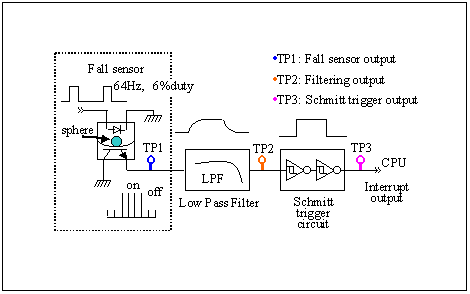
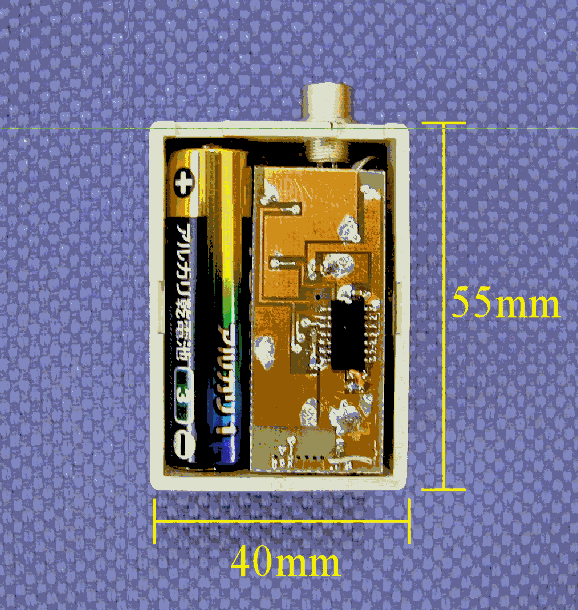
Figure 1 A block diagram of the sensor. Figure 2 A photograph of the fall monitor
Figure 1 shows a block diagram of the sensor circuit. The fall sensor consisted of a photo-interrupter that contained a light emitting diode (LED), photodetector, and sphere-obstruct. In a standing position, light from the LED was received by the photodetector. When the subject tilted or changed posture, the position sphere moved and interrupted the light pathway. There was no electrical or mechanical contact in the device, making it highly reliable for long-term use. The interrupt switch was triggered when the subject inclined at more than 60 degrees, which caused the sphere to move within the fall sensor. The photo-interrupter needed a drive current of about 10 mA. To minimize power consumption, the photo-interrupter was driven with 64 Hz and a 6% duty pulse current, which produced a pulse string waveform output from the fall sensor. A low pass filter was used to demodulate the pulse string waveform and prevent artifacts (fc = 1.5 Hz). The waveform passed from the low filter input, to the Schmitt trigger circuit, to the shape pulse wave, and finally to the CPU as output. Figure 2 shows a photograph of the fall monitor. The external measurements were 55
×40×20 mm. The weight was 59 g, including the battery. The life of the battery was one week and the recording size was 500 points. RS232C communication could be used to set the time, and initialize and transmit the data
The next stage of the research
The falling has been judged only the subject
's physical inclination and the period of time when it leaned by the traditional fall monitor. There is a problem that the fall monitor worked even except for the falling. And the monitor records only the information of time and length when the subject falling. So, it needs more information of falling.When the falling occur, there is a more information except a physical inclination. The impulsive force by the falling has a causal relation between the bone fracture. And the information of direction to the falling has a causal relation between the region of injury. So the condition of the falling can be grasped by measuring acceleration value. I develop fall monitor that used for an accelerometer. Furthermore the omen of the falling is grasped from the acceleration waveform before and after the falling.
Last Updated 2000/10/30
takumi-y@is.aist-nara.ac.jp